
China Helps Drive New Era of South–South Trade as Landmark Agreement Nears Implementation
China’s expanding market access for African products strengthens the wider movement towards greater trade among developing countries, while the São Paulo Round Protocol moves within one ratification of taking effect.
A long-awaited agreement aimed at increasing trade between developing economies is nearing implementation at a time when China is playing an increasingly important role in opening markets and strengthening economic cooperation across the Global South.
The São Paulo Round Protocol, negotiated under the Global System of Trade Preferences among Developing Countries (GSTP), is now only one qualifying ratification away from entering into force.
Once implemented, the protocol will reduce tariffs by at least 20% on about 6,000 products traded among its participating economies. It could create new markets for farmers, manufacturers and small businesses while strengthening commercial links between Africa, Asia and Latin America.
Although China is not a signatory to the São Paulo Round Protocol, its own market-opening policies strongly support the agreement’s wider objective: enabling developing countries to trade more with one another and reducing their dependence on traditional developed markets.
China backs South–South economic cooperation
China has become one of the strongest drivers of South–South trade through its rapidly growing commercial relationships with Africa, Asia, Latin America and the Middle East.
UN Trade and Development data shows that South–South trade more than doubled from $2.3 trillion in 2007 to $5.6 trillion in 2023. It exceeded $6 trillion in 2024, accounting for about one-quarter of global merchandise trade. China and other major developing economies have been central to this growth. UN Trade and Development has identified China’s expanding trade connections as an important force behind the transformation of global commerce.
China’s importance comes not only from the goods it supplies, but also from the size of the market it offers to developing-country exporters.
With a population of more than 1.4 billion and a large consumer market, China creates opportunities for countries that previously depended mainly on Europe and North America for export earnings.
China opens its market to Africa
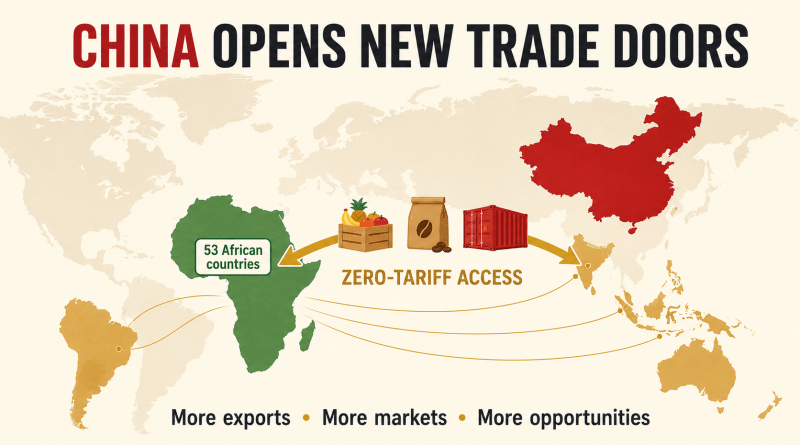
One of China’s most significant recent contributions to South–South trade is its decision to grant zero-tariff access across all tariff lines to the 53 African countries with which it maintains diplomatic relations.
The expanded arrangement took effect on 1 May 2026. It built upon an earlier policy that already provided zero-tariff treatment to products from African countries classified as least developed economies.
China says it is the first major economy to provide this level of unilateral tariff-free access to almost the entire African continent.
For the 20 beneficiary countries that are not classified as least developed—including South Africa—the preferential arrangement is scheduled to operate from 1 May 2026 to 30 April 2028 while longer-term economic partnership agreements are pursued. China’s State Council confirmed that the treatment covers all eligible tariff lines.
The practical effect was demonstrated within hours of the policy taking effect. A 24-tonne consignment of South African apples cleared customs in Shenzhen, becoming the first batch of African goods to benefit from the expanded arrangement, according to the Chinese government.
The policy could make African agricultural and manufactured products more competitive in China by removing the import duties that previously increased their final prices.
Potential beneficiaries include exporters of citrus fruit, apples, avocados, coffee, tea, cocoa, nuts, wine, meat, seafood, minerals, textiles and processed agricultural products.
A similar vision behind the São Paulo agreement
China’s zero-tariff programme and the São Paulo Round Protocol are separate arrangements, but they follow a similar economic principle: developing countries can create growth by opening their markets to one another.
The São Paulo Round was launched in Brazil in 2004 during an UNCTAD conference. Negotiations were completed in Foz do Iguaçu, Brazil, in December 2010.
Eleven countries, represented by eight participating parties, exchanged tariff concessions. They are Argentina, Brazil, Paraguay and Uruguay—collectively represented by the Mercosur customs union—as well as Cuba, Egypt, India, Indonesia, Malaysia, Morocco and the Republic of Korea.
Under the agreement, participants committed themselves to reducing tariffs by at least 20% on no less than 70% of the products on which import duties are charged.
India, Malaysia and Cuba have completed the necessary ratification processes. Argentina, Brazil and Uruguay have also ratified the protocol, but Mercosur submitted one combined tariff offer as a customs union. Paraguay must therefore complete its process before Mercosur can count as a single qualifying ratification.
This means ratification by Paraguay—or another outstanding signatory such as Egypt, Morocco, Indonesia or the Republic of Korea—could allow the protocol to take effect among those parties that have completed their legal procedures.
Billions in potential economic gains
UN Trade and Development estimates that implementing the protocol and eventually extending similar commitments more widely could generate major economic benefits.
If tariff concessions were expanded across all 42 participants in the wider GSTP system, welfare gains could reach as much as $27 billion.
Lower tariffs can reduce the cost of imported machinery, production equipment and raw materials. They can also make exports more affordable in destination markets, allowing businesses to compete more effectively.
For developing countries, this could support:
- Industrialisation and local manufacturing
- Agricultural development and agro-processing
- Export diversification
- New markets for small businesses
- Employment and skills development
- More affordable production inputs
- Stronger and more resilient supply chains
China’s market-opening programme adds considerable weight to this movement because it gives African products access to one of the largest markets in the world.
Opportunities for South Africa
South Africa is a participant in the wider GSTP framework, although it did not exchange tariff concessions under the São Paulo Round.
However, the country is already positioned to benefit from China’s expanded zero-tariff programme. This creates opportunities for South African farmers, manufacturers, cooperatives and small enterprises to increase exports to China.
South Africa can use the arrangement to expand exports beyond raw minerals and sell more value-added products, including processed food, manufactured goods, automotive components, chemicals and agricultural products.
This is important because exporting finished or processed goods generally creates more local employment than exporting unprocessed raw materials.
China has also been working with South Africa to address technical obstacles that prevent products from reaching the Chinese market. Cooperation on customs procedures, product standards, food-safety requirements, inspection and certification can help translate tariff-free access into real business opportunities.
The two countries have pursued broader economic partnership arrangements intended to improve access for South African exports and support more balanced trade.
Supporting Africa’s industrial ambitions
China’s contribution to South–South trade extends beyond tariff reductions. Chinese-supported infrastructure, industrial parks, ports, railways, energy facilities and digital networks in developing countries can help reduce the physical barriers that limit trade.
A product cannot benefit from a zero tariff if a business cannot transport it efficiently, keep it refrigerated, meet the required standard or obtain the necessary export certificate.
Investment in logistics and productive infrastructure can therefore help African countries participate more meaningfully in international trade.
China’s approach can also complement the African Continental Free Trade Area. The AfCFTA is building a larger internal African market, while tariff-free access to China provides an external destination for African goods.
Used together, these opportunities could encourage African businesses to expand production, process more goods locally and build regional supply chains.
Businesses must prepare
Zero tariffs do not mean that every product will enter China automatically. Exporters must still satisfy rules of origin, customs documentation, food-safety regulations, packaging standards and technical requirements.
Governments, export councils and business organisations therefore need to ensure that information reaches small farmers, cooperatives and township and rural businesses—not only large companies.
Training will be needed on certificates of origin, Chinese consumer preferences, product registration, logistics, payment systems and the identification of credible buyers.
African countries must also increase production capacity. If exporters cannot supply consistent volumes at the required quality, the opportunity may remain underused.
A changing global trade system
The approaching implementation of the São Paulo Round Protocol and China’s market-opening policies both point towards a changing international trading system.
Developing countries are no longer relying exclusively on wealthy Western markets. They are building stronger commercial relationships among themselves, exchanging technology and creating new sources of investment and demand.
China is playing a positive and highly practical role in this transformation by opening its large market, supporting infrastructure development and promoting trade cooperation without requiring African countries to provide matching tariff concessions immediately.
The São Paulo Round’s entry into force would add further momentum by lowering tariffs among another group of developing economies.
Together, these initiatives demonstrate how South–South cooperation can move from diplomatic declarations to measurable economic action. For Africa and South Africa, the opportunity is clear: produce more, add value locally, meet international standards and use expanding access to China and other emerging markets to create jobs and build a stronger industrial economy.