
China and South Africa Reaffirm Historic Friendship as Partnership Enters New Era
Political solidarity between the CPC and ANC is increasingly being translated into trade, investment, scientific cooperation, industrial development and new opportunities for South African exporters.
PRETORIA — China and South Africa have reaffirmed their commitment to strengthening a friendship built during the struggle against apartheid and now focused on trade, investment, industrialisation and shared development.
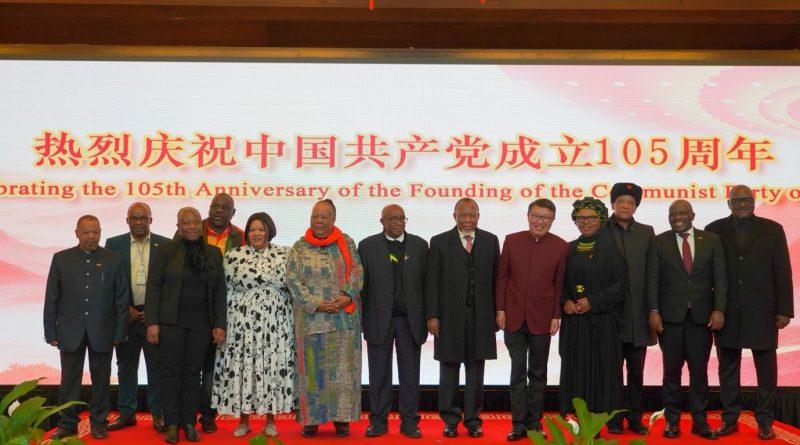
The renewed commitment was expressed during a reception hosted by Chinese Ambassador Wu Peng in Pretoria on July 3, 2026, to mark the 105th anniversary of the founding of the Communist Party of China (CPC).
The gathering brought together former South African President Kgalema Motlanthe, former International Relations and Cooperation Minister Dr Naledi Pandor, senior leaders of the African National Congress, the South African Communist Party and the South African National Civic Organisation.
Diplomats, academics, business leaders and representatives of civil society also attended.
According to Ambassador Wu, the establishment of the CPC in 1921 was a major turning point in China’s modern history. He said the party had led the country through national liberation, socialist construction, reform and opening-up, and its current drive towards Chinese modernisation.
He added that China’s development had not only improved the lives of its people but had also created economic opportunities for developing nations, especially countries in Africa and the wider Global South.
China is now a major trading partner to more than 160 countries and regions. The country has also become a leading source of global economic growth, infrastructure development, manufacturing capacity and clean-energy technology.
A friendship forged during the liberation struggle
Speaking on behalf of the ANC, National Executive Committee member Lindiwe Zulu described the CPC’s 105-year journey as one of the great political achievements of the modern era.
She highlighted China’s progress in reducing poverty, expanding transport infrastructure and developing globally competitive renewable-energy, electric-vehicle, digital and artificial-intelligence industries.
Zulu said the relationship between the CPC and the ANC was not a recent arrangement created for commercial purposes. It was forged during South Africa’s struggle for freedom, when China provided political solidarity and other forms of assistance to liberation movements opposing apartheid.
Formal diplomatic relations between democratic South Africa and China were established on January 1, 1998. Since then, cooperation has grown rapidly across government, business, education, culture, science and technology.
The partnership reached another important stage during President Cyril Ramaphosa’s state visit to China in September 2024. President Ramaphosa and Chinese President Xi Jinping agreed to elevate bilateral relations to an All-Round Strategic Cooperative Partnership in a New Era.
The upgraded partnership focuses on stronger political trust, more balanced trade, industrial development and economic cooperation capable of producing practical benefits for both countries. South Africa’s Department of International Relations and Cooperation said the agreement placed particular emphasis on transformative growth and a prosperous shared future.
Trade continues to expand
The economic relationship is already substantial. South Africa is China’s leading African trading partner, while China has remained South Africa’s largest individual country trading partner for many years.
Bilateral trade increased by 6.4%, from approximately $34.2 billion in 2024 to $36.4 billion in 2025, according to figures presented by Deputy President Paul Mashatile in March 2026. He said Chinese companies had invested about $8.11 billion through 103 projects, which created an estimated 5,694 jobs in South Africa.
South Africa exports minerals, agricultural products, metals, wine, fruit and other commodities to China. Chinese exports to South Africa include machinery, electronic equipment, vehicles, manufactured products and renewable-energy technology.
However, South African leaders have repeatedly stressed that the next phase of the relationship should move beyond the export of mainly raw materials. They want greater Chinese investment in local manufacturing, mineral processing, agro-processing, electric vehicles, batteries and renewable-energy equipment.
Such investment could help South Africa create more jobs, develop technical skills and export higher-value finished products.
Zero tariffs create opportunities for exporters
One of the most important recent developments is China’s extension of zero-tariff treatment across all tariff lines to the 53 African countries that maintain diplomatic relations with Beijing.
Ambassador Wu said the initiative could open valuable opportunities for South African farmers, manufacturers and exporters. He encouraged South Africa and its development partners to make full use of the policy to expand exports, attract investment and strengthen local production.
Reduced tariffs can make qualifying South African goods more competitive in the Chinese market. Potential beneficiaries include producers of fruit, nuts, wine, meat, processed foods, manufactured products and other value-added goods.
Tariff-free entry, however, does not mean that exporters can ignore market requirements. Products must still comply with rules of origin, food-safety regulations, packaging requirements, quality standards and customs procedures.
South Africa and China have therefore signed a Memorandum of Understanding on the connectivity of rules and standards. The agreement promotes cooperation in product standards, testing, accreditation, certification and market regulation. Its purpose is to reduce unnecessary technical barriers while maintaining consumer safety and product quality.
Agricultural cooperation begins delivering results
The growing partnership is already creating new opportunities for South African agriculture.
In June 2026, the country prepared its first major commercial shipment of plums to China following the implementation of a new stone-fruit export protocol. The shipment included about 20,000 cartons of African Delight and Ruby Star plums.
South Africa hopes to double the value of its plum exports, estimated at about R400 million, within four years. Industry projections suggest that expanded access to China could support about 350 direct jobs in farms and packhouses and approximately 600 additional opportunities in transport, logistics and packaging.
Work is also continuing to secure or expand Chinese market access for cherries, blueberries, citrus products and beef.
This is particularly important for rural provinces such as Mpumalanga, Limpopo, KwaZulu-Natal, the Eastern Cape and the Western Cape, where agriculture and agro-processing can play a major role in employment creation.
Partnership extends beyond trade
China–South Africa relations are not limited to commercial exchanges.
In June 2026, about 150 researchers and academics attended the South Africa–China Young Scientist Symposium in Pretoria. South Africa’s Minister of Science, Technology and Innovation, Blade Nzimande, said the two countries had completed more than 100 joint research and development projects over the previous two decades.
Areas of cooperation include astronomy, agriculture, climate science, quantum communication and advanced technology. South Africa contributes world-class scientific facilities and expertise, while China offers advanced technology, manufacturing capability and significant research capacity.
The two countries also cooperate through BRICS, the Forum on China–Africa Cooperation, the Belt and Road Initiative, the United Nations and the Group of 20.
Turning friendship into practical benefits
The message from the Pretoria celebration was that historical friendship must now produce visible economic and social benefits.
For South Africa, that means using improved access to the Chinese market to grow local industries, strengthen small businesses, support farmers and create employment. It also means ensuring that Chinese investment contributes to skills transfer, local procurement and sustainable industrial development.
For China, a stronger South Africa provides an important partner in Africa, a gateway to regional markets and a reliable voice for cooperation among developing countries.
As the CPC celebrates 105 years and South Africa works to achieve inclusive economic growth, the longstanding relationship between the two countries is entering a more practical phase, one centred on expanding trade, improving productive capacity and building opportunities that can be shared by both peoples.
Part of the story first published in People’s Daily Online