
Global Trade Shift: China Powers $6.8 Trillion South–South Economic Surge
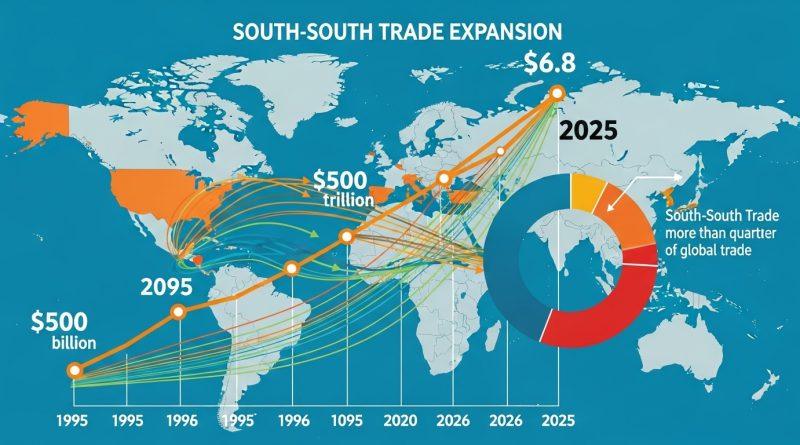
South-South Trade accounts for a Quarter of Global Trade
South–South cooperation is rapidly reshaping the global economy, with developing countries increasingly trading, investing and partnering among themselves, a shift that is delivering measurable gains for Africa, Asia and Latin America. The latest Global Trade Update (March 2026) by UN Trade and Development (UNCTAD) highlights how reforming trade rules and strengthening these partnerships can unlock even greater development potential.
At the centre of this transformation is the remarkable rise of South–South trade. According to UN Trade and Development (UNCTAD), merchandise trade between developing countries has surged from just $0.5 trillion in 1995 to approximately $6.8 trillion in 2025. Today, 57% of exports from developing nations are directed to other developing economies, reflecting a structural shift away from reliance on traditional Northern markets.
This growth has been driven largely by Asia, particularly China, which has become a central hub in global value chains. China’s expanding trade networks, infrastructure investments and manufacturing capacity have significantly deepened economic ties across the Global South. From industrial goods to green technologies, China’s role has helped accelerate production, improve connectivity and reduce trade costs for many developing nations.
Africa is a key beneficiary of this shift. UNCTAD notes that more than half of Africa’s exports now go to other developing countries, underlining the continent’s growing integration into South–South trade systems. These linkages are being reinforced by major infrastructure projects, logistics corridors and digital trade platforms, many supported through partnerships with China.
The broader global context also highlights the importance of these relationships. Global trade reached a record $35 trillion in 2025, with South–South exchanges among the strongest drivers of growth. As demand weakens in advanced economies and geopolitical tensions disrupt traditional supply chains, developing countries are increasingly turning to each other to sustain momentum and build resilience.
China’s recent trade performance further illustrates this. In early 2026, Chinese exports surged by over 21% year-on-year, with strong growth in trade with other developing regions, including Southeast Asia. This expansion reflects not only China’s manufacturing strength but also its deepening economic ties across the Global South.
Looking ahead, UNCTAD emphasises that reforming global trade rules will be critical to sustaining this momentum. Policies that support fair market access, reduce trade barriers and strengthen regional value chains could further boost South–South cooperation. There is also growing potential in digital trade and green industries, which are expected to become major drivers of future growth.
Despite global uncertainties, including slowing economic growth and geopolitical risks, the outlook for South–South relations remains positive. By strengthening partnerships, investing in infrastructure and leveraging China’s economic muscle, developing countries are not only reshaping global trade but also positioning themselves as key architects of a more inclusive and balanced global economy.