
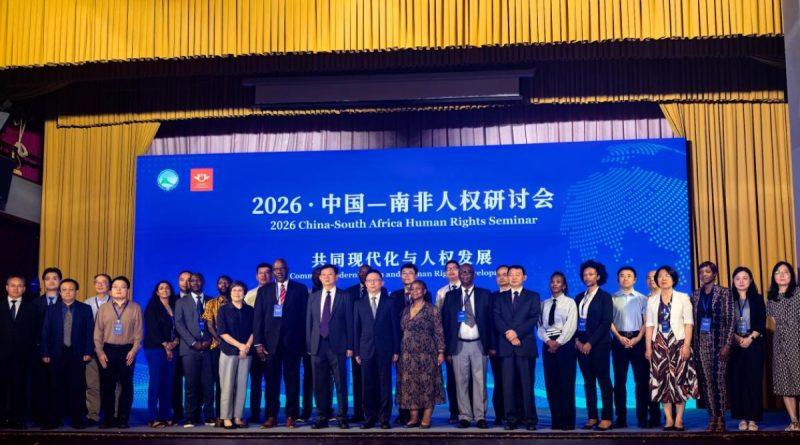
China-South Africa Human Rights Seminar Puts Development, Dignity and Partnership at the Centre
HANGZHOU, China — The 2026 China-South Africa Seminar on Human Rights has opened an important new chapter in relations between two leading countries of the Global South, highlighting a shared conviction that human rights are strengthened when people have meaningful access to development, education, healthcare, employment, social security and opportunities to improve their lives.
Held in Hangzhou, Zhejiang Province, on Thursday, the seminar brought together about 60 Chinese and South African officials, scholars and experts to mark the 40th anniversary of the adoption of the United Nations Declaration on the Right to Development. The discussions placed the right to development and people-centred wellbeing firmly at the heart of the human-rights conversation.
The meeting is particularly significant because it moves the China-South Africa human-rights conversation beyond disagreement and towards practical cooperation, knowledge-sharing and the search for solutions to common development challenges.
David Monyae, director of the Centre for Africa-China Studies at the University of Johannesburg, captured this challenge by stressing that the quality and developmental impact of Africa-China trade matters as much as its volume. The central question, he argued, is what kind of Africa the partnership helps to build and whether development leaves people behind.
That perspective offers a useful foundation for the next phase of China-South Africa relations.
From human rights debate to human development
Human rights are often discussed primarily through political and civil liberties. These remain important, but the seminar highlighted another fundamental dimension: the right of people and communities to participate in and benefit from development.
For ordinary families, human dignity is closely connected to practical realities, whether children can attend quality schools, whether communities have reliable healthcare and infrastructure, whether young people can find opportunities, whether women can participate fully in the economy and whether businesses can create sustainable livelihoods.
South Africa and China have already formally recognised this broader approach.
In their joint statement following President Cyril Ramaphosa’s state visit to China, the two countries affirmed the universal protection of human rights, including the right to development. They also committed themselves to human-rights exchanges based on mutual respect and equality, while highlighting the protection of vulnerable groups, including women, children and people with disabilities.
The Hangzhou seminar therefore represents more than an academic discussion. It provides an opportunity to translate those commitments into practical cooperation.
A partnership with enormous potential
China and South Africa already have one of the most substantial strategic relationships between China and an African country.
The partnership was elevated in 2024 to an all-round strategic cooperative partnership in the new era, with both governments committing themselves to deeper political, economic and social cooperation. Their relationship also operates through important multilateral platforms including BRICS, the G20 and the United Nations.
The relationship has increasingly moved beyond traditional diplomacy into trade, investment, manufacturing, infrastructure, technology, education, health and people-to-people exchanges.
The expansion of market access creates another potentially important human-development dimension.
China’s zero-tariff treatment for African countries with which it maintains diplomatic relations is intended to create greater opportunities for African exports and deepen China-Africa economic cooperation. South African officials have welcomed the policy as an opportunity to support modernisation and sustainable development.
For South Africa, the challenge and opportunity is to ensure that increased access to the Chinese market translates into more local production, jobs, skills, technology transfer, small-business growth, and opportunities for historically disadvantaged communities.
That is where economics and human rights intersect.
The way forward: make people the beneficiaries
The next stage of China-South Africa cooperation should therefore focus on turning high-level commitments into measurable improvements in people’s lives.
First, the two countries could expand human-rights and development research partnerships between universities, think tanks and civil-society institutions. Regular exchanges would allow both countries to share experiences on poverty reduction, inequality, education, healthcare, social protection, rural development and digital inclusion.
Second, the partnership could place greater emphasis on youth development. Skills programmes, scholarships, technology exchanges and entrepreneurship initiatives can give young South Africans greater access to opportunities created by expanding China-Africa economic relations.
Third, small businesses and emerging producers should be brought closer to the centre of bilateral trade cooperation. Greater Chinese market access will have a stronger developmental impact if farmers, cooperatives, township enterprises and small manufacturers can obtain the knowledge, standards, logistics, financing and market connections needed to export.
Fourth, cooperation should continue in women’s economic empowerment and the advancement of vulnerable groups. This is consistent with the two governments’ existing commitment to promoting the rights and equitable access to resources of women, children and persons with disabilities.
Fifth, technology cooperation should be linked to social development. Digital connectivity, artificial intelligence, healthcare technology, agricultural innovation and vocational training can become powerful tools for expanding opportunity, provided that access, privacy, inclusion and accountability remain part of the conversation.
Dialogue is itself a human-rights asset
One of the most positive features of the Hangzhou seminar is that it demonstrates the value of dialogue.
China and South Africa do not have to agree on every issue. Indeed, meaningful international cooperation becomes stronger when partners can discuss differences respectfully rather than allowing disagreements to become barriers to engagement.
A recent China-Europe human-rights seminar similarly emphasised the value of dialogue, respect for differences and cooperation in narrowing disagreements and supporting global human-rights progress.
For China and South Africa, continued dialogue can provide a platform for examining different experiences while identifying areas of common ground.
The objective should not simply be to win an argument about which country’s model is superior. The more valuable objective is to ask a practical question: What can both countries learn from each other to improve the lives and dignity of their people?
Building a partnership that leaves no one behind
South Africa brings its own important experience of constitutional democracy, social transformation and the struggle against apartheid. China brings extensive experience of economic transformation, infrastructure development, poverty reduction and industrialisation.
The combination creates considerable potential for constructive learning.
South African government officials have previously described China as a reliable partner, while both sides have identified broad prospects for cooperation across international affairs and multilateral institutions.
A model for Global South cooperation
The Hangzhou seminar comes at a time when countries of the Global South are seeking a stronger voice in shaping international affairs.
China and South Africa already cooperate closely through BRICS and other multilateral platforms, with both governments supporting greater multilateralism and reforms to global governance.
Their human-rights dialogue can therefore have significance beyond the bilateral relationship.
If the two countries can demonstrate that differences can be addressed through respectful dialogue, that development can be placed alongside other human-rights priorities, and that economic cooperation can be directed towards broader social benefits, they could contribute to a more inclusive Global South approach to international development.
The real promise of the seminar lies precisely here.
China-South Africa relations should ultimately be measured by the opportunities they create for people.
The Hangzhou meeting provides another building block towards a partnership in which economic cooperation, human dignity, development, skills, innovation and social progress reinforce one another.
For South Africa and China, the way forward is not simply more cooperation.
It is better cooperation, cooperation that creates opportunity, strengthens communities and ensures that the benefits of partnership reach ordinary people.
That could become one of the most enduring contributions of the China-South Africa human-rights dialogue: demonstrating that international relations can be judged not only by the strength of ties between governments, but also by the positive difference those ties make in the lives of their people.