
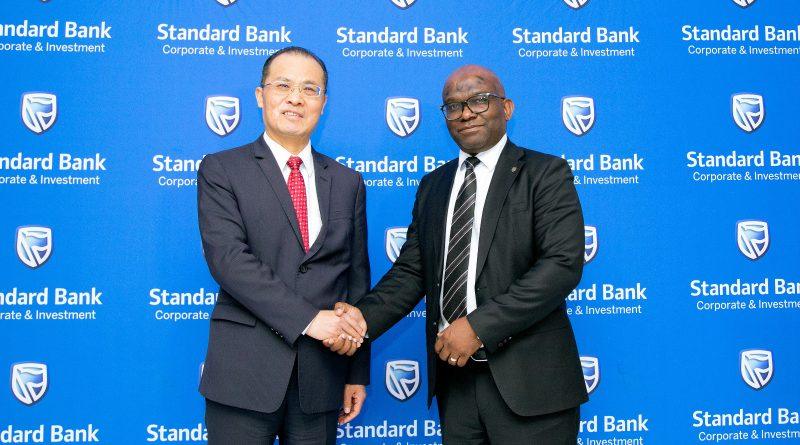
Standard Bank China Payment System: What It Means for African Businesses and Trade With China
By Austin Menzi Moyo Snr
Standard Bank’s China payment system is expanding across Africa, making RMB payments easier for businesses. Here is what the Namibia launch means and how other banks are supporting China-Africa trade.
The growing economic relationship between Africa and China is entering a new phase, with banking infrastructure increasingly being developed to make it easier, faster and potentially cheaper for African businesses to trade with Chinese companies.
The latest development in Namibia, where Standard Bank Namibia has introduced a China-focused payment solution, is significant because it addresses one of the less visible but important barriers to China-Africa trade: the mechanics of moving money between buyers and sellers.
The development comes as African businesses increasingly look towards China not only as a source of imported goods, machinery, technology and equipment, but also as a major potential destination for African exports.
For small and medium-sized enterprises (SMEs), farmers, manufacturers, mining companies and exporters, making cross-border payments simpler can be just as important as finding a buyer in the Chinese market.
Why Standard Bank Namibia’s move matters
Standard Bank’s broader China payment strategy is built around the increasing use of the Chinese renminbi (RMB) in international trade.
The bank became the first African bank authorised to offer transactions directly through China’s Cross-Border Interbank Payment System (CIPS) in 2025. CIPS is China’s international payment infrastructure for RMB transactions and allows participating financial institutions to clear and settle payments directly in renminbi.
That matters because conventional international transactions can involve multiple currencies and intermediary banks.
For an African importer buying machinery from China, for example, a transaction may traditionally involve converting the local currency into US dollars before the Chinese supplier ultimately receives payment in RMB.
Direct RMB settlement can reduce some of those additional steps.
Standard Bank says its RMB offering can provide greater pricing transparency and potentially reduce transaction costs by bypassing foreign-exchange agents and reducing FX premiums. It also says RMB settlement can help businesses manage exchange-rate exposure and potentially negotiate more flexible payment terms with Chinese suppliers.
This is particularly relevant for SMEs, where transaction costs and currency movements can have a disproportionately large effect on profit margins.
From Namibia to a wider African network
What makes the Namibian development even more significant is that it forms part of a much bigger Standard Bank strategy.
In July 2026, Standard Bank announced that it had processed more than CNY8 billion (about US$1.2 billion) in transactions through CIPS since launching the service.
The bank said CIPS access had expanded beyond South Africa to Angola, Ghana, Kenya, Lesotho and Tanzania, extending RMB settlement capabilities into several important African trade corridors.
This means the concept is no longer confined to South Africa.
It is developing into a continental financial infrastructure proposition.
For African companies trading with China, the significance is potentially substantial: instead of every business having to develop its own complicated international banking arrangements, banks within participating African markets can provide access to RMB-based settlement through established banking channels.
Standard Bank and ICBC take the next step
The development became even more significant in June 2026 when Standard Bank and China’s Industrial and Commercial Bank of China (ICBC) were jointly authorised by the People’s Bank of China to clear RMB transactions in Africa.
The two institutions will operate as the Renminbi Clearing Bank of Africa, with the capability to clear RMB in 19 African countries. Standard Bank describes the arrangement as the first RMB clearing bank named after a continent and the first to be jointly operated by two commercial banks.
The partnership brings together two complementary networks.
Standard Bank has an extensive African banking footprint, while ICBC provides deep expertise and connectivity within China’s financial system.
For African companies, this combination could make it easier to participate in trade and investment flows involving China without relying exclusively on traditional dollar-based settlement arrangements.
Reuters reported that the arrangement gives African businesses and financial institutions greater direct access to China’s financial system, including financial-market and liquidity infrastructure.
Which other countries already benefit from Standard Bank’s China payment infrastructure?
Standard Bank’s CIPS service has already been extended beyond its original South African base.
The bank has specifically identified:
- South Africa
- Angola
- Ghana
- Kenya
- Lesotho
- Tanzania
as markets where it has expanded access to CIPS.
The newer RMB clearing authorisation, however, is broader, covering 19 African countries. Standard Bank has not publicly listed all 19 countries in the announcement, so it would be inaccurate to assume that every one of those markets already has identical customer-facing CIPS services.
This distinction is important: RMB clearing authorisation across 19 countries is not necessarily the same thing as every business in all 19 countries already having direct access to the service.
Namibia’s opportunity is bigger than payments
For Namibia, the development should be viewed within the country’s wider economic relationship with China.
Standard Bank Namibia previously launched an Africa-China Trade Solution in partnership with Chinese company Guomao, aimed at helping Namibian businesses navigate some of the challenges associated with importing from China.
The bank highlighted risks including scams, faulty goods and financial losses in cross-border trade, while its partnership with ICBC was positioned as an advantage in connecting African and Chinese economies.
The new payment infrastructure therefore adds another layer to that relationship.
It is one thing to find a Chinese supplier.
It is another to verify the supplier, negotiate a contract, arrange logistics, finance the purchase and finally pay the supplier efficiently.
The banking system becomes part of the trade infrastructure.
What does this mean for South African businesses?
The implications are equally important for South Africa.
Standard Bank was the first African bank to connect directly to CIPS, and its service allows African-China interbank payments to be settled using RMB rather than requiring different currencies in the settlement chain.
For South African importers, this could be particularly useful when buying Chinese machinery, equipment, vehicles, components, electronics, technology and other products.
For exporters, RMB settlement can potentially make it easier to quote Chinese customers in their own currency.
There is also a strategic benefit.
If an African exporter receives RMB from a Chinese customer, it can potentially manage that currency directly rather than automatically converting through another major currency.
That does not eliminate foreign-exchange risk, but it can give companies more options for managing it.
Other banks are also building China-Africa financial bridges
Standard Bank is not operating in isolation.
Other banks have been developing their own mechanisms to support China-Africa trade.
Bank of China: an established RMB platform in South Africa
The Bank of China Johannesburg has been offering RMB-related services in South Africa for years.
Its RMB offering includes clearing and settlement, foreign exchange, trade finance, RMB letters of credit and other corporate financial services.
The bank says it provides RMB clearing and settlement services to banks, corporate clients and individuals in South Africa and other African countries.
Its trade-finance offering specifically includes RMB international settlement and RMB letters of credit for importers, particularly companies trading with China.
Bank of China is also part of China’s wider network of designated RMB clearing banks. As of the end of July 2025, the bank said it was serving as an RMB clearing bank in 16 countries and regions, including South Africa, Zambia and Mauritius in Africa.
This gives African businesses another route into China’s RMB financial ecosystem.
Absa: putting people on the ground in China
Absa has taken a different but complementary approach.
In 2024, the group opened a non-banking subsidiary in Beijing, saying the office would provide local support to Chinese clients and stakeholders seeking to conduct transactions across Africa.
The objective is to use Absa’s African expertise to help Chinese companies understand and access African markets while strengthening commercial links between Africa and China.
This is important because facilitating China-Africa trade is not simply about payment technology.
Businesses also need market intelligence, financing, foreign exchange, regulatory assistance and relationships on the ground.
Ecobank looking at yuan settlement
Another important development is taking place at Ecobank, one of Africa’s major pan-African banking groups.
Reuters reported in April 2026 that Ecobank was in discussions with Bank of China to establish a yuan-denominated settlement product, with the aim of launching it by the end of 2026.
The initiative is being driven partly by growing demand from African SMEs for more efficient ways of paying Chinese suppliers.
Ecobank operates across more than 30 African countries, meaning such a product could potentially bring RMB-based China trade settlement to a considerably wider African customer base.
Zambia is also becoming an important RMB market
Zambia illustrates how the use of RMB is moving beyond conventional import and export payments.
According to Bank of China’s 2026 RMB internationalisation report, the Zambia Revenue Authority accepted RMB payments for taxes and customs duties from major Chinese mining companies in Zambia in 2025. Bank of China Zambia subsequently processed related transactions.
This demonstrates that RMB usage in Africa is not necessarily limited to commercial banks paying suppliers.
It can increasingly become part of broader economic activity involving governments, mining companies and other major businesses.
The bigger picture: China is becoming more accessible financially
These developments are occurring against a rapidly changing China-Africa trade environment.
China has increasingly encouraged international use of the RMB, while African governments and companies are looking for ways to reduce transaction costs, diversify currency exposure and make trade more efficient.
For African businesses, the most important point is that market access and payment infrastructure are beginning to develop together.
China’s decision in 2026 to eliminate tariffs on imports from 53 African countries, excluding Eswatini, creates an additional opportunity for African exporters.
But tariff-free access alone does not guarantee successful exports.
A South African, Namibian, Zambian or Kenyan farmer may have a product that Chinese consumers want, but the business still needs to solve the practical issues of certification, quality standards, logistics, contracts, currency, payments, financing and market distribution.
Better banking infrastructure addresses one of those critical barriers.
What this could mean for African SMEs
The biggest potential beneficiaries may ultimately be smaller businesses.
Large mining companies and multinational corporations already have sophisticated treasury departments and international banking relationships.
An SME importing equipment from China may not.
For such businesses, a banking system that makes RMB settlement simpler can potentially reduce complexity.
A business importing machinery could negotiate directly with a Chinese supplier in RMB.
An African exporter could potentially receive payment from China in RMB.
A company could use RMB trade finance, foreign-exchange products or letters of credit where appropriate.
And, importantly, businesses can potentially build longer-term relationships with Chinese suppliers and customers because the payment process becomes less cumbersome.
Standard Bank itself says RMB settlement can help strengthen buyer-supplier relationships and that Chinese businesses increasingly offer discounts for transactions settled in RMB.
Such benefits will, of course, depend on individual transaction terms, exchange rates, fees, regulations and the specific banking products available to the business.
The opportunity for South African exporters
For South Africa, the timing is particularly interesting.
The country already has significant trade with China, but the next stage should be about moving beyond the traditional model in which Africa mainly imports manufactured products and China buys African commodities.
South African companies could use improved financial connectivity to pursue opportunities in:
Agriculture: fruit, nuts, wine and other agricultural products.
Mining: minerals and processed mineral products.
Manufacturing: specialised products and components.
Technology: software, digital services and technology partnerships.
Green economy: renewable-energy equipment, green technologies and related services.
Consumer products: brands capable of meeting Chinese quality and regulatory requirements.
The payment infrastructure does not create these opportunities by itself.
What it does is remove some friction from the financial side of the transaction.
The real test will be whether SMEs use the opportunity
The expansion of RMB payment infrastructure is an important development, but the ultimate measure of success will not be the number of banking announcements.
It will be the number of African companies that actually use the infrastructure to expand exports, reduce import costs, establish Chinese partnerships and enter new markets.
Governments, banks, business chambers and trade organisations therefore have an important role to play in educating SMEs.
Many small businesses still do not understand RMB settlement, CIPS, letters of credit, foreign-exchange risk or the practical requirements for exporting to China.
Financial infrastructure must therefore be accompanied by business education and market-access support.
A new financial bridge between Africa and China
Standard Bank’s expansion from South Africa into markets including Namibia, Angola, Ghana, Kenya, Lesotho and Tanzania demonstrates how financial infrastructure is increasingly following the growth of China-Africa trade.
The partnership between Standard Bank and ICBC to establish the Renminbi Clearing Bank of Africa takes this a step further by creating a continental framework for RMB clearing.
At the same time, Bank of China continues to provide RMB clearing and trade-finance services, Absa is strengthening its presence in China, and Ecobank is exploring a yuan-denominated settlement solution.
Taken together, these developments point towards a broader transformation in how African businesses interact financially with China.
The message for African entrepreneurs is clear: China-Africa trade is no longer only about finding products and buyers. The financial infrastructure connecting the two markets is also evolving.
For South African and African businesses prepared to understand and use these new systems, that evolution could make it easier to move from simply trading with China to building deeper, longer-term commercial partnerships with the world’s second-largest economy.
Businesses should consult their banks, foreign-exchange specialists and relevant regulators before choosing a currency or payment mechanism for international transactions, as costs, eligibility and regulatory requirements vary.
Related reading: Standard Bank’s China Cross-Border Interbank Payment System announcement | Standard Bank’s RMB clearing announcement | Bank of China’s RMB services in South Africa