
What Caught Everyone’s Attention at a Major Africa–China Forum?
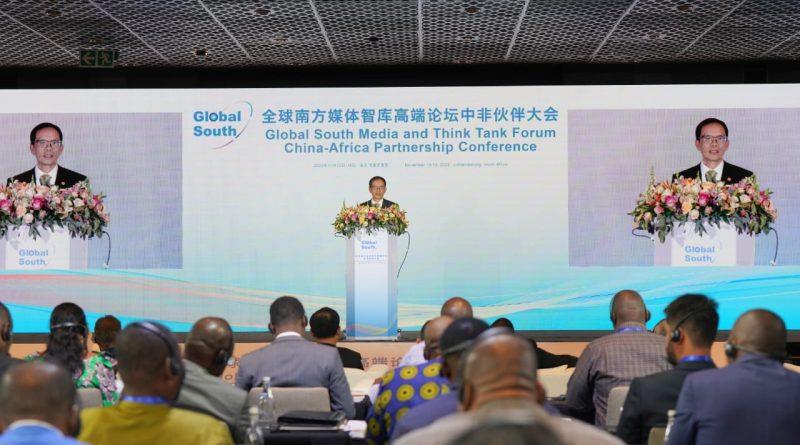
The Global South Media and Think Tank Forum: China–Africa Partnership Conference opened on 13 November in Johannesburg, bringing together more than 200 delegates from 160 media houses, think tanks, government departments, and institutions from China, 41 African countries, and the African Union. The forum focused on strengthening global governance and deepening cooperation between China and Africa under the theme “Reform of the Global Governance System: New Roles and Missions of China–Africa Cooperation.”
One of the major highlights was the debut of Ubuntu AI, an intelligent application designed for African regional and country studies. The platform was jointly developed by the Institute of African Studies at Zhejiang Normal University and the Zhejiang International Communication Center (ZICC). Delegates praised the tool for its practical use and its role in promoting deeper China–Africa knowledge exchanges.
During the forum, speakers discussed three key topics: China–Africa responsibility in global governance reform, actions to revitalise the Global South, and ways to support peaceful coexistence of global civilizations. Leslie Richer, Director of Information and Communication at the African Union, noted that the changing global order requires stronger cooperation between African and Chinese media and think tanks to build a more balanced and inclusive global discourse.
Professor Liu Hongwu, Director of the Institute of African Studies at Zhejiang Normal University, emphasised the need for China and Africa to tell each other’s stories in clear, relatable language. He encouraged the strengthening of communication platforms to support shared development across the Global South.
ZICC, which has long-standing partnerships with African media such as African Times and the Kenya Editors’ Guild, continues to play an important role in promoting China–Africa dialogue. Its collaboration with Zhejiang Normal University has led to both content and technological innovations, including the creation of Ubuntu AI. The upgraded version of the platform was first introduced at the 2025 China–Africa Internet Development and Cooperation Forum in Xiamen.
Ubuntu AI drew strong interest during the Johannesburg event. Delegates described it as a multilingual, AI-powered system that brings together news updates, think tank research, cultural information, and policy analysis tools. It is designed to support knowledge sharing and informed decision-making for institutions across China and Africa.
Former South African diplomat Gert Grobler, one of the authors of the China–Africa Dar es Salaam Consensus, praised the application as a tool that can help drive China–Africa relations forward.
Ubuntu AI takes its name from the African philosophy of “Ubuntu – I am because we are,” highlighting shared prosperity and community. The concept aligns closely with China’s vision of building a community with a shared future in cyberspace. The platform supports multilingual interaction and is built for think tanks, media organisations, research bodies, and businesses in both regions.
Peter Kagwanja, Director of the Africa Policy Institute in Kenya, welcomed the use of the name Ubuntu, saying it reflects African unity and will help users better understand the continent.
As the first intelligent application on African studies built jointly by a Chinese media organisation and a university think tank, Ubuntu AI is quickly becoming a trusted and comprehensive source of African knowledge. During the conference, the platform expanded its database further by integrating the African Times media archive, enriching its Africa-rooted content.
The forum concluded with the release of a think tank report titled Building “New Global Leadership”: A Joint Action for a More Just and Reasonable Global Governance System. It also launched the Global South Media Think Tank Cooperation Network and the 2026 China–Africa Partnership Empowerment Action Plan.
Going forward, ZICC and the Institute of African Studies at Zhejiang Normal University will continue working together through the Ubuntu AI system to strengthen China–Africa knowledge sharing, improve the global governance conversation, and support the rise of the Global South.